

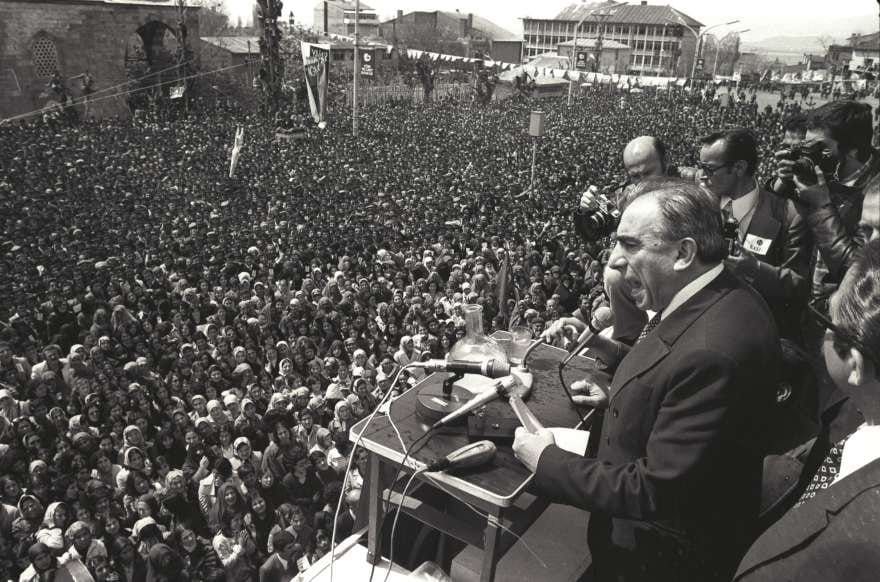
Few political figures in modern Turkish history attempted to formulate an integrated national doctrine as systematically as Alparslan Türkeş. His book Dokuz Işık ve Türkiye (1976) was not written merely as a party programme or electoral vision, but as an effort to define a comprehensive worldview—historical, moral, economic, and political—aimed at rescuing Turkey from what he perceived as structural decline, ideological dependency, and civilizational confusion.
The “Nine Lights” (Dokuz Işık) represent Türkeş’s attempt to articulate a Turkish nationalist alternative to both Western liberal capitalism and Marxist internationalism during the Cold War era. While deeply controversial, the doctrine remains one of the most influential ideological frameworks in modern Turkish political thought.
Historical Diagnosis: Power, Nations, and Reality
A central premise of Dokuz Işık ve Türkiye is Türkeş’s insistence on historical realism. Drawing extensively on world history, he rejects moralistic idealism detached from power. His argument is blunt:
In international relations, rights are protected only by strength.
Türkeş does not celebrate brute force for its own sake. Rather, he argues that justice without power is ineffective, and that nations which fail to secure material, military, and moral strength are condemned to dependency. He cites examples ranging from the Sino-Soviet split to Indo-Pakistani wars to demonstrate that ideological slogans—internationalism, brotherhood, universal equality—collapse when national interests collide.
This realism forms the backbone of his nationalism: the nation is the ultimate political actor, and survival depends on organization, discipline, and self-confidence.
Turkish History as Civilizational Proof
Türkeş devotes substantial space to Turkish history, not as romantic nostalgia but as evidence of civilizational capacity. He divides Turkish history into two broad phases:
- Pre-Islamic Central Asian period, marked by organization, mobility, and state-building.
- Islamic and Western expansion, culminating in the Seljuk and Ottoman empires.
Against claims that Turks merely conquered without creating civilization, Türkeş argues that no society lacking moral discipline, administrative skill, and collective purpose could sustain multi-continental empires. For him, Ottoman decline was not caused by Turkish identity or Islam, but by:
- Loss of national ideal (ülkü)
- Intellectual imitation of the West without understanding its foundations
- Breakdown of elite–people unity
- Moral and economic stagnation
This diagnosis directly informs the Nine Lights.
The Nine Lights: Core Principles
Türkeş presents the Nine Lights not as abstract slogans, but as mutually reinforcing pillars of national revival.
1. Nationalism (Milliyetçilik)
Not racial supremacy, but national self-respect, historical consciousness, and unity. A nation must believe in its own worth before it can act creatively.
2. Idealism (Ülkücülük)
A society without a unifying ideal becomes inert. Idealism provides direction, sacrifice, and meaning, binding generations together.
3. Moralism (Ahlâkçılık)
Economic growth without ethics leads to decay. Türkeş insists that moral discipline precedes national strength, not the other way around.
4. Social Solidarity (Toplumculuk)
Rejecting both class warfare and laissez-faire individualism, Türkeş advocates a corporatist harmony between labor, capital, and state.
5. Scientificism (İlimcilik)
True independence requires mastery of modern science and technology. Blind traditionalism is as dangerous as blind imitation.
6. Popularism (Halkçılık)
Elitism is a national poison. Intellectuals and leaders must remain organically connected to the people, not alienated from them.
7. Industrialism (Endüstricilik)
Political sovereignty without industrial capacity is illusory. Türkeş places heavy emphasis on national production and modernization.
8. Developmentalism (Gelişmecilik)
Development must be planned, continuous, and nationally directed, not dictated by foreign dependency or short-term consumption.
9. Freedom and Order (Hürriyetçilik ve Şahsiyetçilik)
Individual dignity matters—but only within a framework of national responsibility and social order.
Religion and Society
Türkeş treats religion not as a political instrument but as a moral foundation of society. Faith provides meaning, restraint, and cohesion. However, he rejects both clerical domination and militant secularism, arguing instead for a nationally rooted moral order compatible with reason and modern life.
In his view, a society that destroys its spiritual foundations in the name of progress ultimately becomes directionless and manipulable.
Criticism of Westernization and Imitation
One of the book’s sharpest critiques is aimed at uncritical Westernization. Türkeş argues that Ottoman and Republican elites imitated Western forms—military uniforms, consumption patterns, lifestyles—while ignoring the deep structural foundations of Western power:
- Scientific method
- Industrial organization
- Capital accumulation
- National discipline
Imitation without understanding, he claims, produced dependency rather than modernization.
Legacy and Controversy
The Nine Lights doctrine shaped Turkish nationalist politics for decades, inspiring movements, organizations, and youth cadres. At the same time, it has been criticized for:
- Authoritarian tendencies
- Overemphasis on order
- Ideological rigidity
- Association with political violence in the 1970s
Yet even critics acknowledge that Türkeş attempted something rare: a coherent, indigenous ideological system, grounded in history rather than imported theory.
Conclusion
Dokuz Işık ve Türkiye is best understood not as a timeless manual, but as a Cold War-era nationalist response to perceived existential threats, communism, cultural dissolution, economic dependency, and moral collapse. Whether one agrees with Türkeş or not, the work remains a key document for understanding Turkish political thought, nationalism, and the intellectual anxieties of the late 20th century.
For Codex Cumanicus, Alparslan Türkeş stands not merely as a political leader, but as a doctrinal thinker who sought to answer a fundamental question:
How can a nation remain itself – strong, moral, and sovereign- in a world governed by power?
References
- Selected historical and ideological analysis based on primary text synthesis (Introduction, “Görüş,” historical chapters)
- Alparslan Türkeş, Dokuz Işık ve Türkiye, Kervan Yayınları, Istanbul, 1976
